
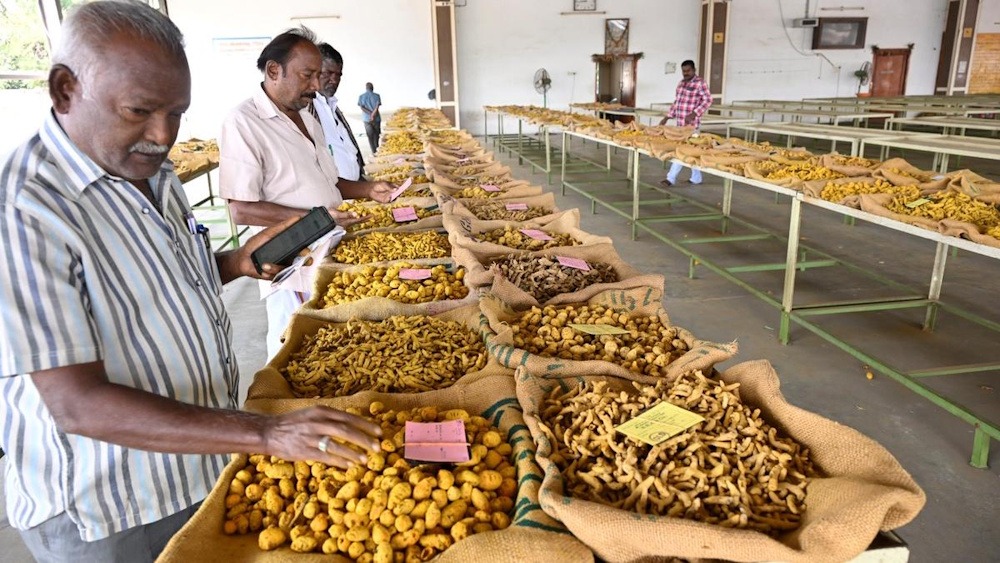
Turmeric prices experienced a significant decline yesterday, settling down by 2.98% at Rs 16,666. This drop was driven by anticipations of increased acreage due to favorable monsoon conditions prevailing during the current sowing season. For the 2026 harvest, India’s turmeric crop is developing with an increase in planted area; however, net supply is expected to see only moderate growth, as weather irregularities and localized disease challenges counterbalance the gains in acreage. Unseasonal heavy rains during August–September resulted in waterlogging and disease in certain regions of Marathwada, affecting approximately 15% of the area, with yield losses ranging from 15% to 20% in the impacted areas of Maharashtra, Andhra Pradesh, and Karnataka.
For the period of 2025–26, the estimated acreage for turmeric stands at 3.02 lakh hectares, reflecting an increase of approximately 4% year-on-year, with fresh production anticipated to reach 11.41 lakh tonnes. Dried turmeric output across India is projected at 90 lakh bags, an increase from 82.5 lakh bags in the previous season. However, diminished carry-forward stocks are constraining the overall rise in availability.
Maharashtra’s dried output is anticipated to increase to 54 lakh bags, whereas other producing states are projected to contribute approximately 40 lakh bags. Despite the short-term pressures, the potential for downside seems constrained as arrivals continue to fall short of normal levels, and both farmers and stockists have markedly diminished their inventories. Domestic and export demand continues to exhibit robustness, bolstered by increasing exports to Europe and the USA alongside a decline in imports.
From a technical perspective, the market is experiencing renewed selling pressure, as indicated by a 0.76% increase in open interest alongside a price decline of Rs 512. Support is identified at Rs 16,388, beneath which prices could approach Rs 16,108, whereas resistance is established at Rs 17,124 and subsequently at Rs 17,580.